To make your website develop and get a better position on Google, you have to know the basics of SEO. You can consider it as the foundation or the “ground” of all your search engine optimization activities. No matter how sophisticated the SEO methods, unable to perform well in search results. Without a strong base, even the most sophisticated SEO techniques won’t help your website to become visible in search results.
In this manual, we will go through the definition of foundational SEO the reasons for its importance and we will also give you the techniques to do the SEO optimization on your website. Moreover, the readers will also become aware of the basic principles of SEO that each and every website owner or digital marketer should adhere to. The language used in this article is very simple and easy to comprehend making it ideal for beginners.
What is Foundational SEO?
Before going further let’s first clarify what is foundational SEO .
Foundational SEO is the procedure to configure your website in such a manner that search engines can effortlessly detect, decipher, and catalog your content. It includes the necessary processes such as keyword analysis, site organization, technical setup, on-page optimization, and the production of quality content.
In simple words, foundational SEO entails achieving the fundamentals correctly before proceeding to the advanced techniques. Just as one constructs a house, you need to have a robust foundation before any other construction can take place, otherwise, everything above could just come off.

Why Foundational SEO Matters.
A lot of people directly go to the heavy duty SEO tactics such as link building, using paid tools, and applying advanced analytics. But if your base is not strong enough, these efforts will not yield good results.
The following are the reasons for which foundational SEO optimization is so important:
- Better visibility:– Makes it straightforward for search engines to grasp your content.
- Improved user experience:- A well organized site has a shorter loading time and is more user friendly.
- Higher rankings:- Following basic SEO principles improves your chances of ranking.
- Long-term success:- Strong foundations make future SEO strategies more effective.
If your website isn’t ranking, the problem might be in the foundation not in your content or backlinks.
The 7 Pillars of Foundational SEO
Let us carefully analyze the seven pillars of base SEO. They are all straightforward and are the same that cover the ground for a strong website.
1. Keyword Research:- The First Step
All the basic things in SEO revolve around keywords.
Keywords enable search engines to determine the subject of your content and also facilitate users in discovering the pages.
The process of keyword research:
- Use free keyword research methods like Google Keyword Planner or Ahrefs.
- Select keywords that correspond to your target audience’s search intent.
- Concentrate on a mixture of short tail and long tail keywords.
- Steer clear of keyword stuffing times, rather, devise an appealing content use of them.
For example, if the topic you are writing is foundational SEO, then along with that,
you might be targeting what is foundational SEO and foundational SEO optimization as well.
This stage is one of the most powerful ones among the basic SEO principles as it brings you the right audience right from the get-go.
2. Website Structure and Navigation
A clean and simple website structure is very beneficial as much for the users as for the search engines. When the website is convenient to navigate, the visitors’ stay is longer and Google does not have any problem crawling your pages.
Suggestions for good website structure:
- Engage a clear hierarchy (Home > Category > Subpage).
- Make your URL short and explain its content.
- Make internal links between related pages.
- Do not allow orphan pages (pages without internal links).
Excellent structure is a support to your whole foundational SEO optimization and it makes sure that Google can discover all your main content.
3. On-Page SEO Optimization
On-page SEO is concerned with the optimization of the individual web pages in a site to get higher rankings and is one of the main areas of foundational SEO.
Key on-page elements to optimize:
Title Tags:- Incorporate your primary keyword in a natural way.
Meta Descriptions:- Create captivating summaries (not more than 160 characters).
Headings (H1, H2, H3):- Use keywords naturally in headings
Alt Text for Images :- Helps search engines understand your visuals.
Content Quality:– Original, clear, and valuable information.
Example :- If your article is about foundational SEO, your title could be:
“Foundational SEO: Understanding the Basics for Better Rankings”
This improves your click-through rate and ranking potential.
4. Technical SEO Essentials
No foundational SEO optimization would be complete without addressing the technical side of your website. Technical SEO simply ensures that your site works properly and loads fast.
Technical SEO checklist:
Mobile Friendly Design :- The website should look and work great on all devices.
HTTPS:- Use SSL certificates in order to make your website secure.
Fast Loading Speed:-Compress images, use caching, and choose good hosting.
Sitemap:- Upload your sitemap to Google Search Console.
Robots.txt:- Tell Google which pages to crawl or to ignore.
These are simple but powerful basic SEO principles that build your website’s technical strength.
5. High Quality Content
Even with ideal technical settings, your website will not do well without good content. Quality content earns trust, engages readers, and signals relevance to search engines.
Tips for writing great content:
- Write in a clear and natural tone-like this guide!
- Use your keywords in a natural flow.
- Provide real value and solve your reader’s problems.
- Add visuals, examples, and subheadings for easy reading.
When you follow foundational search engine optimization, the content becomes friendly for a user and search engine.
6. Internal and External Link Building
Links are important in search engine optimization. Internal links connect the pages within your website, while external links, or backlinks, come from other websites pointing to yours.
Internal Linking Tips:
- Link to other related pages from within the text naturally.
- Use descriptive anchor text.
- Avoid broken links.
External linking tips:
- Get backlinks from trusted websites.
- Avoid spammy and paid links.
- Create linkable, shareable content.
A well structured linking pattern enhances the overall foundational SEO setup.
7. User Experience (UX)
Google takes into consideration the behavior of the users on-site, how long they stay, whether they bounce quickly, and if they explore multiple pages.
How to improve UX:
- Use clean design and readable fonts.
- Avoid too many pop ups.
- Make buttons and menus easy to click.
- Ensure your website loads fast.
A great user experience not only is of much help to visitors but also raises your ranking, thus making it a part of foundational SEO optimization.
Understanding the Core Basic SEO Principles
Let’s dive a bit deeper into some basic SEO principles that support foundational SEO:
- Relevance: Your content should be relevant to what users are searching for.
- Quality: Information should always be useful, unique, and fresh.
- Crawlability: Search engines read your pages with ease.
- Indexing: Only content-rich pages are worth indexing.
- Authority: Gain trust through backlinks and high-quality content.
These principles remain the same, even while Google’s algorithm changes. They are at the heart of foundational SEO and should never be ignored.
Foundational SEO Optimization Process: Step-by-Step
If you’re new to SEO, here’s a simple step-by-step process to apply foundational SEO optimization to your website.
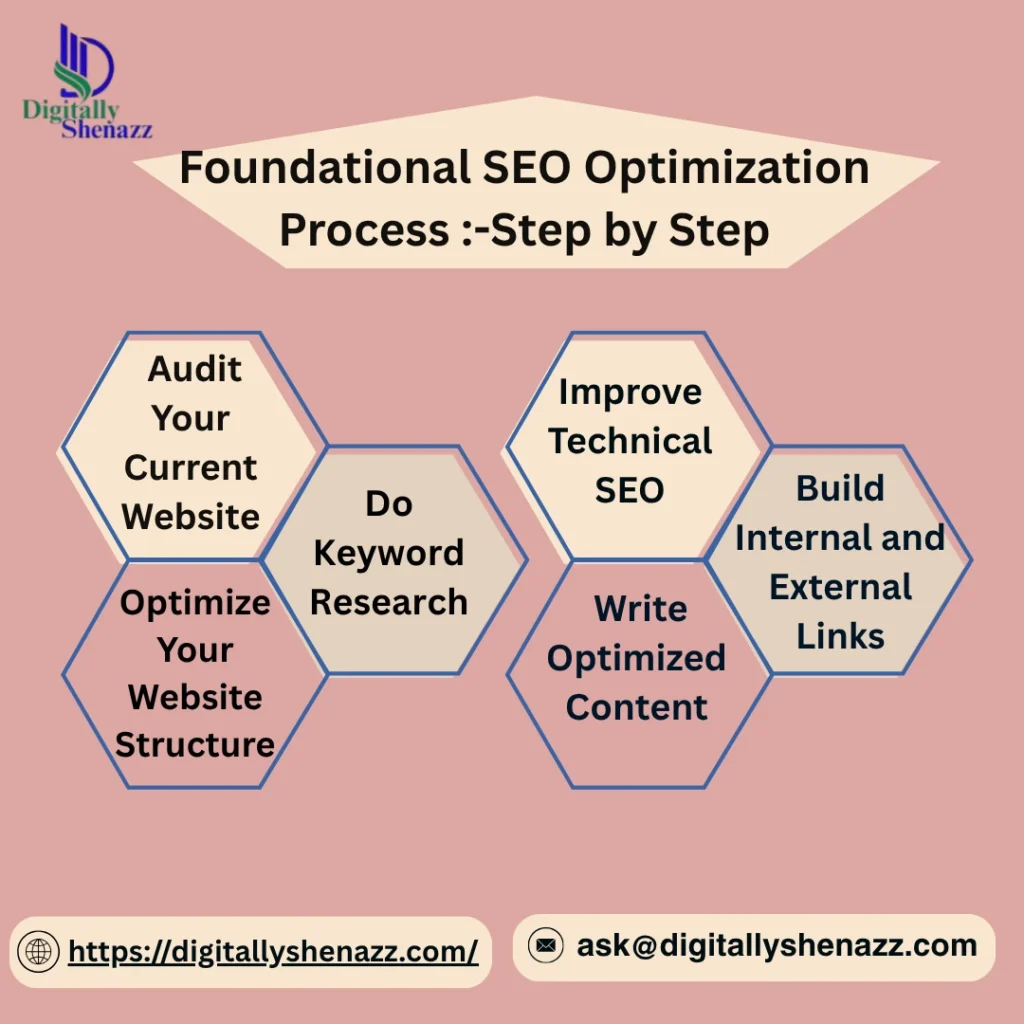
Step 1: Audit Your Current Website
Check your site health with tools such as Google Search Console, Ahrefs, or Ubersuggest. Look for broken links, missing meta tags, and slow-loading pages.
Step 2: Do Keyword Research
Find actual keywords that your audience is searching for. Start with a core keyword, such as “Foundational SEO,” and find related terms.
Step 3: Optimizing Website Structure
Organize your pages logically. Design a simple menu and use internal links to connect related content.
Step 4: Improve Technical SEO
- Fix crawl errors.
- Use HTTPS.
- Submit a sitemap.
- Make your site mobile-friendly.
Step 5: Write Optimized Content
Build natural keyword mentions into your titles, headings, and body, but stay focused on solving for the reader.
Step 6: Build Internal and External Links
Add internal links to connect your pages and get backlinks from trusted sources.
Step 7: Monitor and Improve
Monitor your progress through Google Analytics and Search Console. Update the content regularly.
By following this foundational SEO optimization process step by step, your website will have everything that Google looks for.
Common Mistakes to Avoid in Foundational SEO
Even simple mistakes can hurt your rankings. Here are a few to avoid:
- Ignoring mobile optimization.
- Using duplicate content.
- Not writing unique titles and meta descriptions.
- Stuffing too many keywords.
- Forgetting to check for broken links.
Avoiding these errors is part of applying good basic SEO principles.
Tools to Help You with Foundational SEO Optimization
Here are some useful tools to help you build and maintain your SEO foundation:
Google Search Console:- for monitoring indexing and crawl issues.
Google Analytics:- tracking user behavior.
Yoast SEO / Rank Math (WordPress):- For on-page SEO assistance.
GTmetrix / PageSpeed Insights:- For loading speed improvement.
Ubersuggest / SEMrush:– For keyword research and SEO audits.
These tools will make foundational SEO optimization a lot easier, even for beginners.
Foundational SEO vs. Advanced SEO
Foundational and advanced SEO are often mixed up. The difference is really simple:
| Foundational SEO | Advanced SEO |
| Focused on setup and structure | Focuses on deep strategies such as link building. |
| Builds the base of your site | Builds authority and visibility |
| Includes keyword basics, meta tags, sitemaps | Includes analytics, automation, and AI tools |
| Ease for beginners | For advanced SEOs |
Before going to advanced SEO, perfect the foundational SEO; otherwise, advanced efforts will not yield good results.
The Long-Term Benefits of Foundational SEO
By following fundamental SEO practices and applying basic SEO optimization, your website will:
- Load faster and perform better.
- Rank higher for your target keywords.
- Attract more organic traffic.
- Build long-term authority.
- Provide better user experience.
This is not a one-time thing. it’s an ongoing process that helps your website grow steadily.
Final Thoughts
Foundational SEO is the backbone of any successful website. If you lack foundational SEO, your content, backlinks, and ads won’t be as effective. With a focus on foundational SEO optimization and adherence to basic SEO principles, you set your site up for lasting success. Start with fixing your architecture, improving speed, writing good content, and helping Google understand your site better. When the foundations are strong, you can easily move to the advanced level of SEO strategies.