Creating a content marketing strategy for SEO can seem difficult when you are new to digital marketing. You may understand that blogs, keywords, and search engines are important, but you may not know how to bring them together into one practical plan. The good news is that you do not need advanced SEO knowledge to get started. With clear goals, audience research, keyword research, search intent, useful content, and regular improvements, beginners can build a strategy that supports long-term organic growth.
A content strategy is more than simply writing blog posts and adding keywords. It is a process of deciding what your audience needs, which topics are worth covering, how different pages connect, and how you will measure their performance.
In this guide, we will explain how beginners can create an effective SEO focused content plan from the beginning. You will learn how to choose topics, understand search intent, organize keywords, create useful articles, build topic clusters, use internal links, and improve existing content.
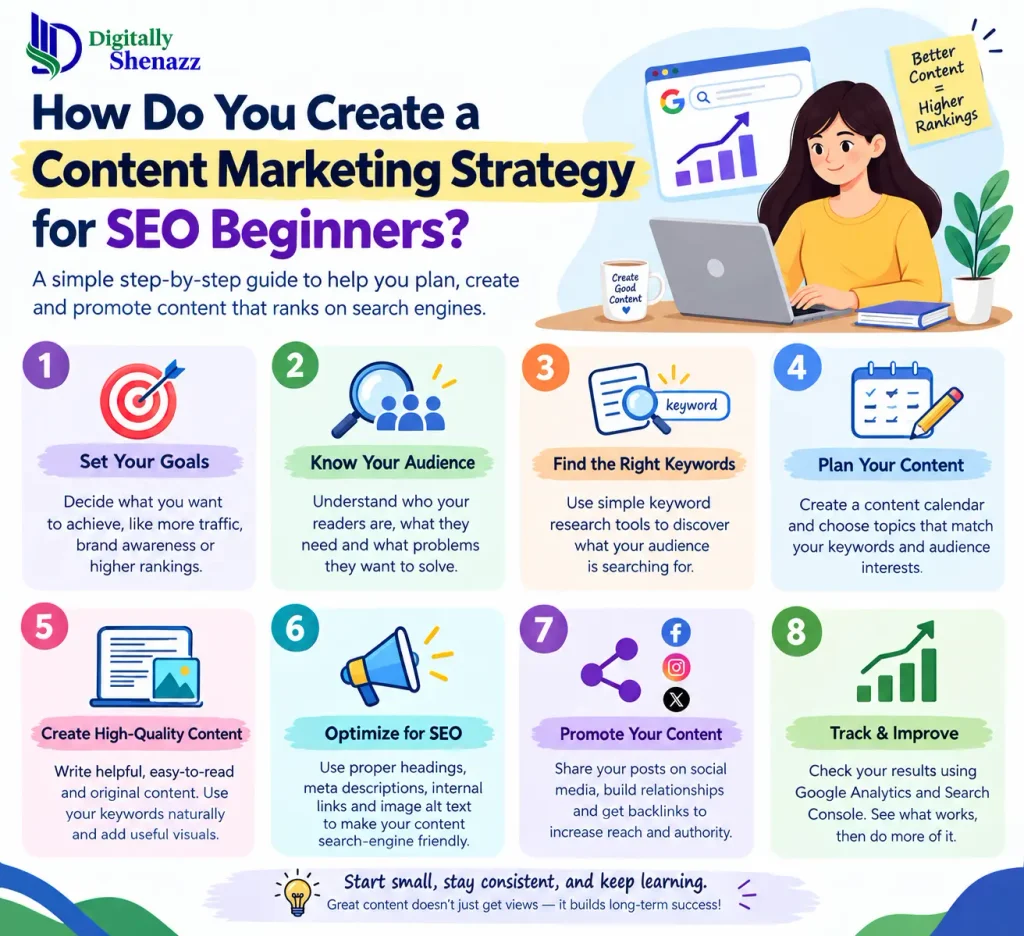
What Is a Content Marketing Strategy for SEO?
A content marketing strategy for SEO is a planned process for researching, creating, publishing, optimizing, and updating website content to attract relevant visitors from search engines.
Instead of writing articles randomly, you create content around topics that are useful to your target audience and relevant to your website.
For example, imagine that you have a website about digital marketing. You could create articles about keyword research, on-page SEO, technical SEO, content writing, local SEO, SEO tools, and blogging.
These subjects are connected. When they are organized properly, they can create a useful resource for readers who want to learn about search engine optimization.
The main purpose is not simply to rank for as many keywords as possible. The goal is to create valuable pages that answer questions and provide information people are actually looking for.
A good strategy considers several elements together:
- Audience needs and problems
- Keyword research and related topics
- Search intent
- Content quality and usefulness
- Website structure and internal links
- Content performance and updates
This approach helps turn individual blog posts into a connected content system.
Why Should Beginners Have a Content Strategy?
Many new bloggers start by publishing whatever topic comes to mind. After a few weeks or months, they may have many articles but no clear connection between them.
A strategy helps prevent this problem.
When you plan your content before writing, you can identify important topics, avoid unnecessary duplication, create supporting articles, and decide which pages should be linked together.
It also makes your work more efficient.
For example, suppose your main topic is SEO keyword research. Instead of writing five articles that explain almost the same thing, you could create one detailed guide and then publish supporting content about long-tail keywords, keyword intent, keyword mapping, competitor research, and keyword tools.
This creates a clearer content structure.
A strategy also helps you stay focused on your audience. Before creating an article, you can ask a simple question:
What problem will this content solve for the reader?
If you cannot answer that question, the topic may need more research before you start writing.
Why Content Marketing Is Needed for SEO?
Many beginners wonder why content marketing is needed for SEO when factors such as technical optimization and backlinks are also important.
Content provides useful information that search engines can understand, and users can consume. It gives a website opportunities to answer questions, explain subjects, target relevant searches, and demonstrate knowledge within a particular area.
For example, a website about SEO can create content covering keyword research, search intent, on-page optimization, technical SEO, content optimization, and SEO reporting.
Each page can address a different question while contributing to the website’s broader subject.
However, creating content does not guarantee rankings. Search visibility can depend on many factors, including relevance, competition, website quality, technical accessibility, content usefulness, links, and the expectations behind a search query.
That is why a strategy should focus on creating the right content rather than simply creating more content.
How to Build a Content Marketing Strategy for SEO?
Now let’s look at the practical process beginners can follow.
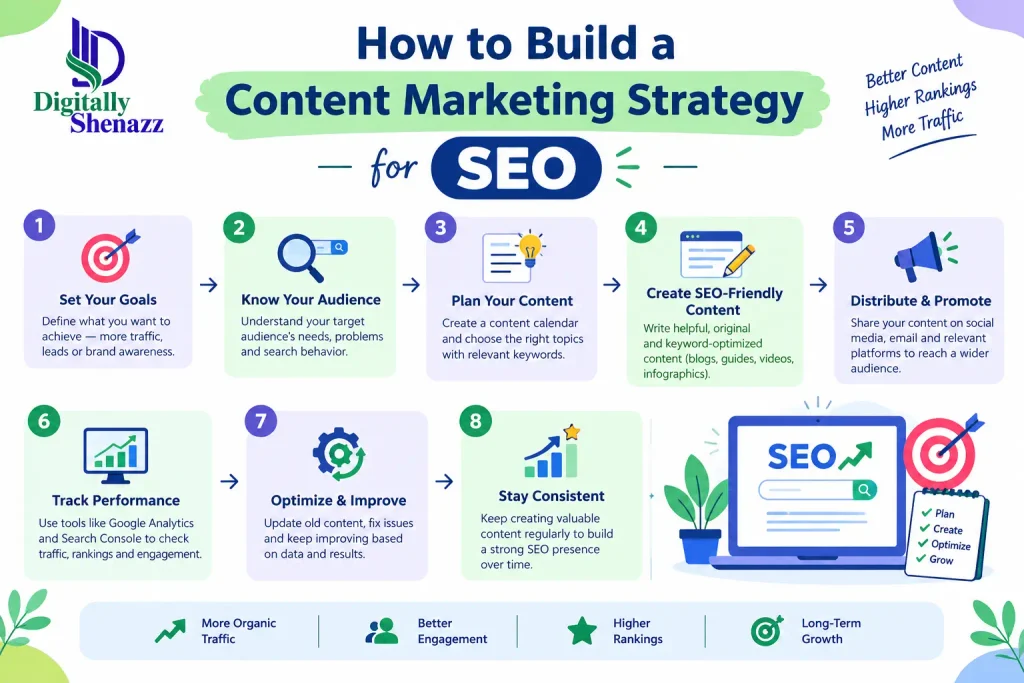
Define Your Main Goal
Before researching keywords, decide what you want your content to achieve.
Your objective could be increasing organic traffic, educating readers, building brand awareness, generating leads, supporting product pages, or establishing expertise in a specific subject.
Your goal affects the type of content you create.
For example, an educational website may focus primarily on guides, tutorials, explanations, and informational articles. A business website may combine educational content with service pages, comparison articles, case studies, FAQs, and commercial content.
Do not worry about creating a perfect plan immediately. Start with one clear objective and build from there.
Identify Your Target Audience
The next step is understanding who you are writing for.
Consider their knowledge level, problems, questions, goals, and reasons for searching online.
A beginner searching for “what is SEO” needs a simple explanation. Someone searching for “advanced technical SEO audit process” may already understand the basics.
Your writing should match the reader’s knowledge.
If your target audience is beginners, avoid unnecessary jargon. When technical terms are required, explain them in simple language.
For a website such as Digitally Shenazz, the audience may include bloggers, new website owners, digital marketing learners, and businesses looking for practical SEO information. Content can therefore focus on clear explanations, examples, tutorials, and actionable learning.
Research Relevant Keywords
Keyword research helps you discover what people search for.
Start with a broad topic and expand it into related questions and phrases.
For example, if your main subject is SEO content writing, related ideas could include:
- SEO content writing tips
- How to write SEO-friendly content
- SEO writing for beginners
- How to optimize blog content
- Content optimization techniques
- SEO blog writing
Do not select keywords only because they have high search volume.
A keyword should be relevant to your website and useful for your audience. A highly competitive keyword may require significant effort, while a specific long-tail query may attract fewer but more relevant visitors.
Look at search volume, competition, relevance, search intent, and the type of content currently appearing in search results.
Understand Search Intent
Search intent is the reason behind a person’s search.
Someone searching “what is technical SEO” is probably looking for an explanation. Someone searching “best SEO tools” may be researching available tools. A person searching for a particular brand may simply want to reach that website.
Understanding intent helps you choose the right content format.
Before writing, search your target phrase and examine the results. Are they guides, tutorials, lists, product pages, videos, or definitions?
This gives you clues about what users may expect.
Do not copy the competing pages. Instead, use them to understand the topic and then create something clearer, more useful, or more complete.
Create Topic Groups
Once you have keywords, organize them into related groups.
Suppose your main subject is SEO. You could create topic groups such as:
Keyword Research:
Keyword research guide, long-tail keywords, keyword intent, keyword mapping, keyword tools.
On-Page SEO:
Title tags, meta descriptions, headings, internal linking, image optimization.
Technical SEO:
Crawling, indexing, XML sitemaps, robots.txt, page speed, mobile usability.
Content SEO:
SEO writing, content optimization, search intent, content gaps, topic clusters.
This structure helps you understand what content you already have and what is missing.
It can also make internal linking easier because related articles naturally support one another.
Create Topic Clusters
A topic cluster consists of several connected pages covering different parts of a larger subject.
For example, your main article could explain “SEO for Beginners.” Supporting articles could cover keyword research, technical SEO, on-page SEO, content writing, and link building.
The main guide can link to these detailed articles, while the supporting pages can link back to the main resource where appropriate.
The purpose is to help readers move naturally between related information.
You do not need dozens of pages to create a cluster. Start with a small group of genuinely useful articles and expand it as your website grows.
Build a Content Calendar
A content calendar gives you a simple publishing plan.
It can include the article title, target topic, keyword, search intent, content format, publishing date, and status.
You do not need to publish every day.
For many beginners, one well-researched article each week may be more realistic than publishing several low-quality articles.
A calendar also helps prevent repeated topics.
For example, before writing a new article, check your existing content. You may discover that you already have a page covering a similar question. Instead of creating another competing article, you could improve the existing one or create a more specific supporting article.
Write for Readers First
SEO should support your content, not control every sentence.
Write in a natural style and explain concepts clearly.
Avoid repeating the same keyword unnecessarily. Search engines can understand related concepts and context, so useful content does not need to sound robotic.
For example, an article about keyword research can naturally discuss search queries, search intent, long-tail keywords, keyword difficulty, competitor research, content planning, and search behavior.
Use examples whenever a concept may be difficult to understand.
Imagine that someone completely new to SEO is reading your article. Would they understand it without opening another website to explain every term?
If the answer is yes, your content is probably easier to use.
Optimize the Main On-Page Elements
After writing the article, review the important on-page elements.
Your main topic should be clear from the page title, introduction, headings, and overall content.
Pay attention to the title tag, meta description, URL, H1 heading, H2 headings, internal links, image alt text, and content structure.
Do not force keywords into every heading.
Headings should help readers understand the article. A natural heading such as “How Search Intent Works” may be more useful than repeating the exact target phrase.
SEO optimization should make the page easier to understand, discover, and navigate.
Use Internal Links Strategically
Internal links connect pages within the same website.
They help visitors discover related information and make website navigation easier.
Suppose you publish an article about SEO content writing. You could naturally link to related articles about keyword research, search intent, on-page SEO, or technical SEO.
The link should make sense in context.
Avoid adding links simply to increase the number of internal links. Ask whether the linked page gives the reader additional information.
A useful internal-link structure can also help search engines discover and understand relationships between pages.
Create Useful Local Content
Local businesses can use content to answer questions from people in specific locations.
Content marketing for local SEO can include location-specific guides, local customer questions, service information, FAQs, local industry topics, and useful resources.
For example, a digital marketing business serving local companies could create an article explaining how small businesses can improve their online visibility in their area.
The important point is to provide genuine local information.
Simply adding a city name to a generic article does not automatically make it valuable local content. The topic should actually help people in the relevant location.
Improve Content Quality
Before publishing, read your article as if you were the target reader.
Check whether the introduction clearly explains the topic. Make sure important questions are answered and unnecessary sections are removed.
Look for outdated information, unclear sentences, repeated ideas, and unsupported claims.
Also check your formatting.
Long blocks of text can be difficult to read. Use meaningful headings, short paragraphs, examples, tables, images, or other formats when they improve understanding.
The goal is not to make an article look longer. The goal is to make the information easier to understand.
How Can Beginners Measure Content Performance?
After publishing, monitor what happens.
Search performance tools can show which queries are generating impressions and clicks. Analytics data can help you understand how visitors interact with your website.
Some useful signals include:
- Search impressions and clicks
- Click-through rate
- Search queries
- Organic traffic
- Engagement with the page
- Pages that attract new visitors
- Articles that need improvement
Do not judge an article based on one metric alone.
For example, a page may receive many impressions but relatively few clicks. That could be a reason to review the title and meta description.
Another article may attract visitors but fail to answer their questions clearly. In that case, improving the content structure may be more useful than simply adding more keywords.
Search data can also reveal unexpected queries. These can provide ideas for updating existing articles or creating new supporting content.
When Should You Update Old Content?
A content strategy does not end when an article is published.
Information changes. Search behavior changes. Competitors publish new resources. Your website also grows.
For these reasons, review older articles periodically.
Check for outdated information, broken links, missing sections, old examples, weak introductions, and opportunities for stronger internal linking.
You should not change an article’s date just to make it appear fresh. Make meaningful improvements that genuinely increase its usefulness.
For example, if an older article contains five important steps but current knowledge suggests that readers need two additional steps, update the article with useful information.
Regular improvement can become an important part of your long-term content process.
Common Mistakes Beginners Should Avoid
Creating SEO content for the first time can involve trial and error.
One common mistake is choosing topics only because they have high search volume. A popular keyword is not automatically the right keyword for your website.
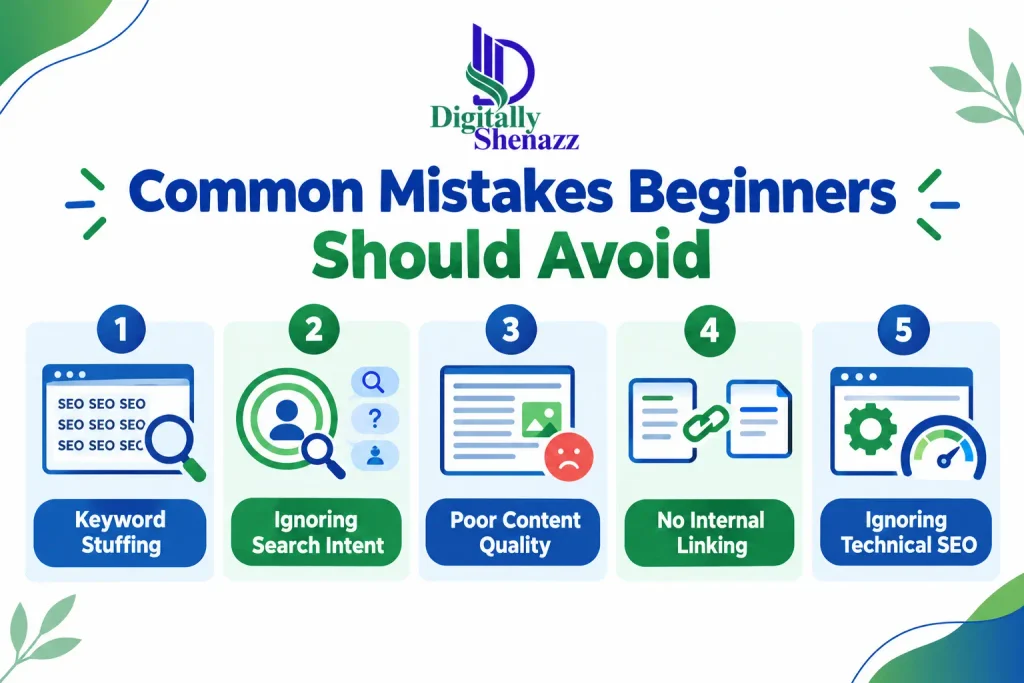
Another mistake is writing multiple articles about nearly identical subjects. This can make your content library confusing and may cause pages to compete for similar searches.
Keyword stuffing is another problem. Repeating a phrase excessively can make an article uncomfortable to read and does not automatically improve its search performance.
Some beginners also publish articles without adding internal links. If related pages exist, connect them where the relationship is genuinely useful.
Another mistake is expecting immediate results. SEO can take time, particularly for new websites and competitive subjects.
Most importantly, do not forget the reader. A page created only to target a keyword may fail if it does not provide a satisfying answer.
A Simple Beginner Workflow
If all of this sounds complicated, start with a small process.
Choose one important subject related to your website. Research the questions people ask about it. Select topics based on relevance and search intent. Create one useful article, optimize its basic on-page elements, and connect it to related pages.
Then monitor its performance.
After publishing several articles, look at your search data and identify what is working. You can use that information to improve existing pages and plan future topics.
Over time, your website can develop a collection of connected resources rather than a random list of blog posts.
For example, Digitally Shenazz can build content groups around SEO basics, keyword research, technical SEO, AI SEO, content writing, blogging, and digital marketing. Each group can contain beginner-friendly articles that answer specific questions and link naturally to related resources.
This approach keeps content creation organized and gives readers a clear path to learn more.
Final Thoughts
Creating a successful content marketing strategy for SEO does not require beginners to know everything about search engine optimization.
Start by understanding your audience and defining your goal. Research relevant keywords, but do not focus only on search volume. Understand search intent before choosing an article format. Organize related topics into clusters and create a realistic publishing schedule.
When you write, focus on answering the reader’s question clearly. Use keywords naturally, add relevant internal links, optimize important on-page elements, and make your content easy to read.
After publishing, use performance data to understand what readers are searching for and which pages need improvement.
The most effective strategy is not necessarily the one that produces the largest number of articles. It is the one that consistently creates useful information for the right audience and improves over time.
For beginners, the best approach is to start small, stay consistent, learn from real search data, and build your website’s content around genuine user needs.
Frequently Asked Questions
1. What is the first step in creating an SEO content strategy?
The first step is to define your website’s goal and understand your target audience. Once you know who you are writing for and what you want your content to achieve, you can research relevant topics and keywords.
2. How important is keyword research for content marketing?
Keyword research helps you understand what people are searching for and what questions they may have. However, keywords should be used naturally. Relevance and search intent are more important than simply repeating a phrase many times.
3. How often should beginners publish SEO content?
There is no universal publishing frequency. Beginners should choose a schedule they can maintain while producing useful, well-researched content. One high-quality article per week can be more practical than publishing several weak articles.
4. What is search intent in SEO content?
Search intent is the reason behind a search query. A person may want to learn something, find a specific website, compare options, or complete an action. Understanding the intent helps you create content that matches what the searcher expects.
5. Are topic clusters useful for new websites?
Yes. Topic clusters can help new websites organize related information. You can begin with a small group of closely connected articles and expand the cluster as your website develops.
6. Should every blog post target a different keyword?
Not necessarily. Different pages can target closely related queries when they satisfy different search intents. However, creating several pages that provide almost the same answer can create unnecessary duplication.
7. How long does SEO content take to rank?
There is no fixed timeframe. Results can depend on competition, website history, content quality, relevance, technical SEO, links, and other factors. New websites may need time to build search visibility.
8. Should I update old blog posts?
Yes, when there is a genuine reason to improve them. Updating outdated information, adding useful sections, improving internal links, correcting errors, and making the content more helpful can keep older resources useful.