AI for SEO is changing the way search engines comprehend the content and how the content is matched with the intent of the users. Previously, the primary focus of search engine optimization was to comprehend the algorithm and align the content with the user’s search intent. However, with the progression of technology, search engine optimization is changing rapidly too. AI for SEO is changing the way websites are ranked, the way content is created, and the way businesses are competing with each other.
What Is AI for SEO?
AI applied to SEO refers to the use of artificial intelligence technologies to enhance SEO processes. Rather than relying on pure manual research, guesswork, or traditional tools, AI can analyze large volumes of data to identify patterns, trends, and opportunities.
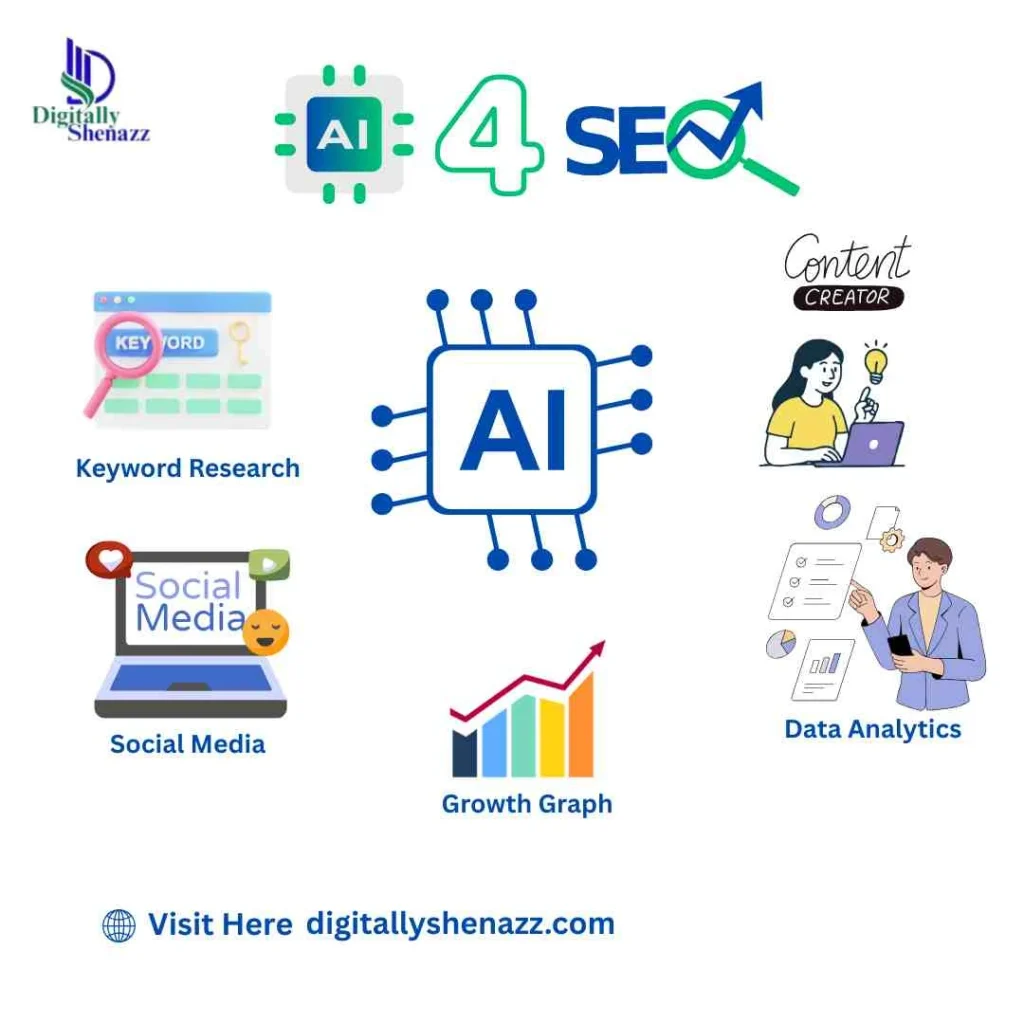
AI assists the SEO practitioners by:
- Knowing the purpose of the search better.
- Robotization of monotonous assignments.
- Anticipating opportunities in ranking.
- Real user behavior optimization of content.
Already, search engines such as Google are overreliant on AI to rank pages. It implies that marketers too will be forced to keep up with the changes with AI-based solutions and concentrate on the SEO of AI rather than conventional optimization tools.
The Importance of AI in SEO in the Present Digital World
SEO is now more competitive than ever. Millions of blog posts are being posted each day and it is not easy to be on the first page. This is where AI in SEO comes into play.
1. Search Engines Are AI-Driven
Recent search algorithms use machine learning to comprehend the content context, user interest and activity. Without optimization of the assessment by AI, your material will not rank well.
2. Quick and Smoother Decision-Making
SEO AI can analyze large volumes of data within a few seconds and assist the marketer in discovering the insights that would otherwise require weeks to reveal through human effort.
3. Better User Experience
AI is concerned with the interaction with the content by the user. With the help of the alignment of SEO strategies and the analysis of AI, a website may provide more relevant, engaging, and helpful experience.
4. Competitive Advantage
Early adopters of AI in search engine optimization have an advantage over firms that continue to use the old ways of optimization.
The influence of AI on Traditional SEO
Old-fashioned SEO was based on the frequent use of keywords on the pages, backlinks and the simplest on-page optimization. Although these factors are also significant, AI has transformed the way they are considered.
1. Smarter Keyword Research
AI analyzes instead of using exact match keywords:
- Semantic relationships
- User intent
- Search behavior patterns
This renders artificial intelligence tools of SEO very strong in the detection of high-value keywords that have real ranking opportunities.
2. Quality and not quantity of content
AI-based search engines are rewarding helpful, well-structured, and human-written content. Such a change renders the search engine optimization of AI regarding clarity, relevance, and usefulness not manipulation.
3. Predictive SEO
The ranking changes, traffic trends, and content performance can be predicted by AI and therefore can be optimized before issues arise instead of running corrections.
AI SEO Tools: How and why are they important?
The AI-based SEO tools are created to automatically improve and optimize various areas of optimization. These tools are to aid human imagination, and not to replace it
1. Topic Discovery Keyword Research
AI tools understand search history and propose topics of active search, which result in the creation of content according to demand.
2. Content Optimization
AI evaluates:
- Readability
- Keyword placement
- Semantic relevance
- Content depth
This will make sure that the content is in expectation of the search engine and the user.
3. Technical SEO Improvements
AI tools can detect:
- Crawl issues
- Broken links
- Page speed problems
- Mobile usability issues
4. Competitor Analysis
Competitor strategy can be analyzed with AI tools that indicate:
- Content gaps
- Backlink opportunities
- Ranking weaknesses
SEO, Search Engine Optimization, Smart Search Engines
Although it is crucial to ensure that you use AI tools in SEO, SEO in AI is concerned with ensuring that your content is easily read and indexed by the AI-driven search engines.
1. Focus on Search Intent
AI does not assess what someone searches, but the reason. Content must clearly match:
- Informational intent
- Navigational intent
- Transactional intent
2. The Natural Language and Context
AI knows conversational language. Naturally, human-written content is more successful than robotic text full of keywords.
3. Structured Content
Enhanced headings, brevity in paragraphs, bullet points, and logical organization make a better contribution towards the AI interpretation of your information.
4. Topical Authority
AI Optimization also favors websites that present issues in depth instead of writing superficial information on many topics.
Benefits of Using AI for SEO
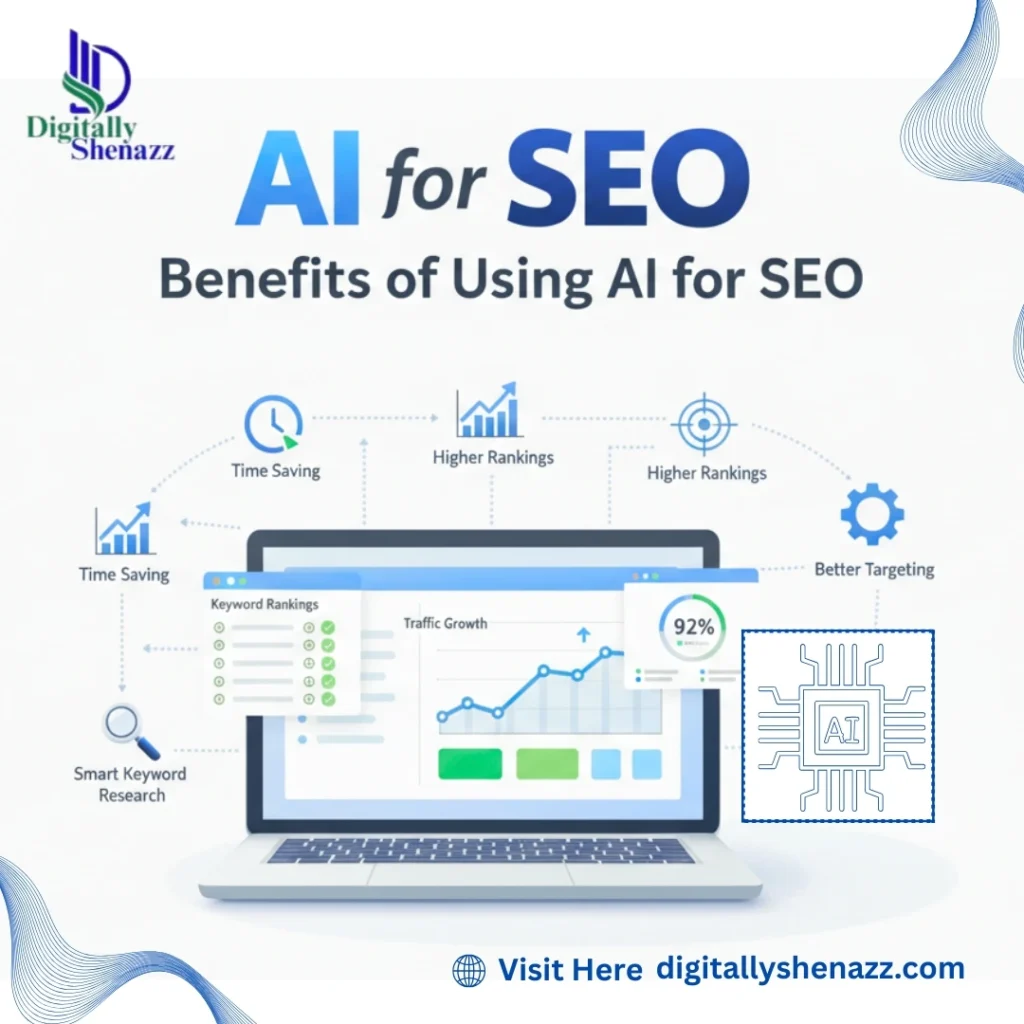
1. Time Efficiency
AI will be used to automate repetitive functions such as auditing, reporting and analysis of data.
2. Data-Driven Decisions
The use of AI in SEO is based on actual information, thereby minimizing guesses and enhancing precision.
3. Improved Rankings
Optimization is made according to better insights, which results in higher rankings.
4. Enhanced Content Quality
AI points out points where the content may be enhanced to be more readable and relevant.
5. Scalability
With AI, it becomes less complicated to handle SEO in large sites that have hundreds or thousands of pages.
Common Myths About AI for SEO
Myth 1: AI Replaces SEO Experts
AI assists in the process of decision making but does not substitute human ingenuity, tactics and emotional sense.
Myth 2: The Content generated by AI always ranks.
Value, originality, and trust are still required for content. Rankings cannot be ensured by AI only.
Myth 3: SEO Is Dead Because of AI
SEO is not fading away, it is changing. AI optimization is merely the next step of optimization.
Challenges of AI for SEO
Although it has benefits, AI in SEO does not pass without difficulties.
1. Over-Automation
Too much automation may cause generic or replicated material.
2. Learning Curve
The knowledge of utilizing AI tools as a means of SEO comes with time and trial.
3. Data Dependency
The AI accuracy relies upon the quality of input data.
Moral and Quality Issues.
SEO strategies should make sure that the contents are original, correct and user-oriented.
The Ultimate Guide to SEO using AI and Still a Human
The balance is essential to work with AI in search optimization.
1. AI to Research, Not to be creative
Storytelling and emotional connection should be the responsibility of humans, whereas data
Analysis should be left to AI.
2. Revise and Optimize AI Recommendations
AI outputs are to be revised, refined and tailored on a regular basis.
3. Focus on Value
Google does not distinguish between the content that is created with good intentions and that content that really assists the users.
The Content Role in AI-based SEO
In an AI-driven world, content is always the base of SEO.
1. Quality Over Quantity
AI prefers comprehensive and research-intensive work.
2. Readability Matters
Engagement is enhanced by the use of short sentences, clear language and logical organization.
3. User Experience Signals
AI helps in the analysis of bounce rate, time on page, and interaction to identify content value.
The Content Role in AI-based SEO
1. Voice Search Optimization
Voice assistants that operate on the basis of AI are transforming the search patterns of users.
2. Visual and Video SEO
Images and videos are both analyzed more and more by AI to determine their relevance.
3. Predictive Search Behavior
AI will predict what the users need prior to the search.
4. Individualized search results
Ai SEO will entail location, behavior, and preference personalization.
The AI SEO Success Best Practices
- Write for humans first
- Strategically use AI tools in SEO.
- Focus on topical authority
- Please maximize on purpose, rather than only on keywords.
- Measuring performance and changing.
Final Thoughts
Yes. Artificial intelligence as a form of search engine optimization is here to stay. It is the future of online optimization. Companies that learn to leverage AI tools to optimize their search engine performance and learn to optimize AI for search engines will dominate the search results in the next few years.
It is not to be afraid of AI, but to adopt AI wisely. Being integrated with human creativity, strategic thinking, and substantial value creation, AI can be one of the strongest partners in the success of SEO.
When you concentrate on quality, relevancy, and experience to the user, AI on SEO will not only improve your rankings, but also create credibility and authority in your specific niche over the long term.